FairHelm
Contact

Academy

  • Looking for a different week?
  • How you moor the yacht to the dock
  • Stern to the dock and bow to a rock
  • Wind, current, and drift before the approach
  • Back off and come in again
  • Knots for mooring
  • Your own sports insurance
  1. Home
  2. /Courses
  3. /Mooring workshop: back off and come in again

Mooring workshop: back off and come in again

ISSA accreditation.

Last updated: February 13, 2026

  • Croatia
  • Seven days
  • no more than four people
  • 1,000 to 2,000 euros

Mooring workshop: stern to the dock, bow to a rock, or a buoy. Seven days, no more than four people. Six nights, Saturday evening to Saturday morning. The range for the week is 1,000 to 2,000 euros a person.

Contact
Mooring workshop: back off and come in again

Looking for a different week?

If you were looking for the first week on a yacht, open the page Yacht Crew.

If you need to set and adjust the sails, open the page Workshop for setting and adjusting the sails. This week does not set the sails.

If you are already ready to lead the yacht near shore yourself, open the page Inshore Skipper.

Which step to take is on the page How to become a skipper.

How you moor the yacht to the dock

The dock is the place the boat comes in to. On the drawings the bow is the pointed end of the boat, and the stern is the straight end. Stern to the dock, and three other ways, are below.
Four ways to come in

  • Drawing: the stern toward the dock

    Stern to the dock

    The back of the boat faces the dock, and the bow faces the water.

  • Drawing: the side along the dock

    Alongside

    The side of the boat lies along the dock. Bow and stern lines hold it in, and springs, the diagonal lines, stop it sliding along the dock.

  • Drawing: the bow toward the dock

    Bow in

    The bow, the front of the boat, faces the dock. You come in this way when you are not sure there is water under the stern: the rudder stays farther from the shallow place. You usually step ashore from the stern.

  • Drawing: the boat at a buoy

    A buoy

    The boat is tied to a floating mark, not to the dock.

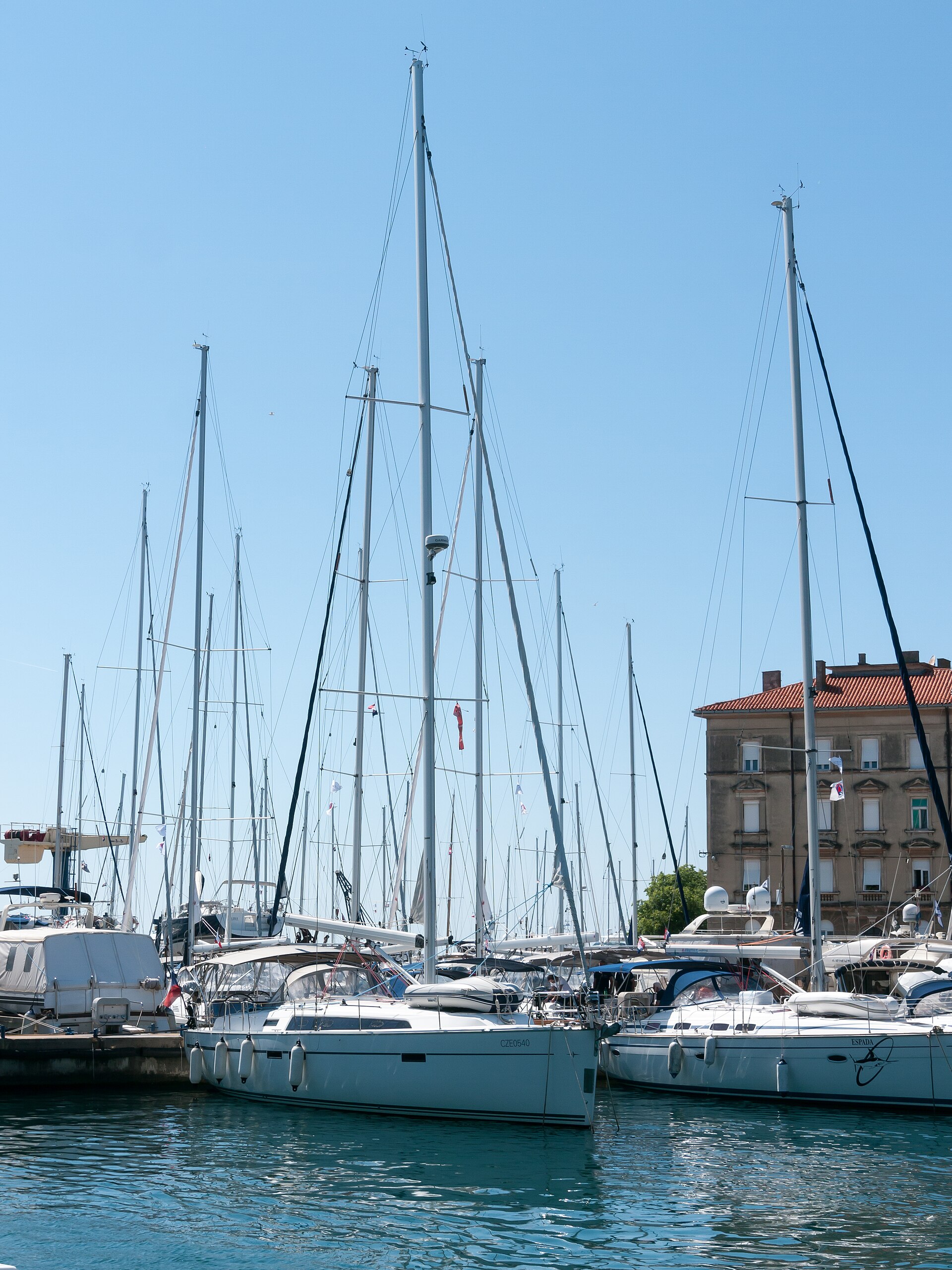
Sailboats in Zadar marina, already moored. This is not the minute of the approach and not a FairHelm training.
Sailboats in Zadar marina, already moored. This is not the minute of the approach and not a FairHelm training. Matti Blume, CC BY-SA 4.0

Stern to the dock and bow to a rock

Stern to the dock on the Mediterranean is not held the same way as bow to a rock in Sweden. The drawings show what holds the bow, and where the anchor goes.

The Mediterranean and a rock

  • Drawing: the line from the bottom to a block

    A line from the bottom

    On the Mediterranean, where the anchors of the boats next to you would catch each other, the bow is held by a line that is already lying in the water. It leads to a heavy chain or a concrete block on the seabed. You pick it up at the dock and lead it to the bow, so the stern is not pressed against the dock.

  • Drawing: an anchor from the bow, stern at the dock

    Your own anchor from the bow

    When that line is not there, you let the anchor go from your own bow while the stern goes toward the dock. You then take up the chain, and the stern stays at its distance from the dock.

  • Drawing: the bow at the rock, the anchor from the stern

    Bow to the rock

    In Sweden the bow comes up to the rock, and you let the anchor go from the stern. The bow lines go to a ring or a bolt already set in the rock, or to a tree. The rudder stays farther from the rock. Before you stay, you look whether the wind will be onto the rock by morning. A wet rock is slippery, and you leave the lines so you can let them go from the boat.

  • Drawing: the side along the rock

    Alongside the rock

    You lie this way only when the depth, the wind, and the rock itself allow it. A rock is not a flat dock, and the fenders here are not all the same. When the place does not suit, bow to the rock with an anchor from the stern is the steadier way.

A finger, two posts, and the side of another boat are already not a flat dock and not a rock.

A finger, piles, and another boat

  • Drawing: the boat at a finger

    A finger

    A narrow pontoon sticks out from the dock. The boat lies alongside it, stern toward the main dock, and you step off from the side.

  • Drawing: the boat between piles

    Piles

    Two posts stand in the water. The bow line goes to the nearer post, the stern line to the farther one, and the boat between them does not swing with the wind.

  • Drawing: two sides together

    Alongside another boat

    A short stay: fenders between the sides, lines onto the next boat. In Sweden you also lie this way at a rock, when the place beside you is already taken.

Wind, current, and drift before the approach

While the boat is still sitting, the hand already wants to head for the dock. First you look at the wind, the current, and the drift. Once the boat has started, those three things cannot be read again.

What you look at before the approach

  • Drawing: the wind before the approach

    The wind

    You look at where it comes from while the boat is still sitting.

  • Drawing: the current along the dock

    The current

    You look at where the water carries the boat, so it is not carried past the gap you were aiming for.

  • Drawing: the boat off the line

    The drift

    The boat slides off the line you meant to follow. On the drawing that line is dashed, and the boat is already beside it.

Back off and come in again

The boat is going into the wrong gap, and the end of the line is still in the water. You take the boat off the dock and come in once more. That move is called back off and come in again. You take the line in at once, so it is not wound onto the propeller. The propeller turns under the water and moves the boat.

When the boat is going the wrong way

  • Drawing: the approach misses the dock

    The approach misses

    The boat is going into the wrong gap between the boats next to you.

  • Drawing: the second approach to the dock

    Back off and come in again

    On the drawing the first approach is dashed, and the solid boat is the second. A shout from the dock does not put the boat into the right gap.

Knots for mooring

On the week you work through the various knots mooring needs. The order in which the line is led is not written out on this page: it is shown on the boat.

Who stands where at the dock is written on the page Crew roles on a bareboat. A fender is the soft cushion between the side and the dock, or between two boats, so the side does not hit.

Your own sports insurance

For the teaching days it makes sense to have your own sports insurance. The school does not sell it here.

What the payment includes and what it does not

  • What is included

    The payment includes this week, counted per person.

  • What is not included

    Travel, food, transfer, tickets, your own medicine, and your own insurance are not in the payment.

Leave a request or ask a questionWe reply within 2-3 days.